
The inventory of fixtures is not mandatory for a holiday let. The law that requires it for a main residence does not apply here. But the authorities strongly recommend it. Without it, you cannot prove the origin of any damage or justify a deduction from the deposit. Here is how to carry it out, plus a template to download.
Is an inventory of fixtures mandatory for a holiday let?
No. Holiday lets fall outside the law of 6 July 1989. It is this law that makes the inventory of fixtures mandatory, but only for the tenant's main residence.
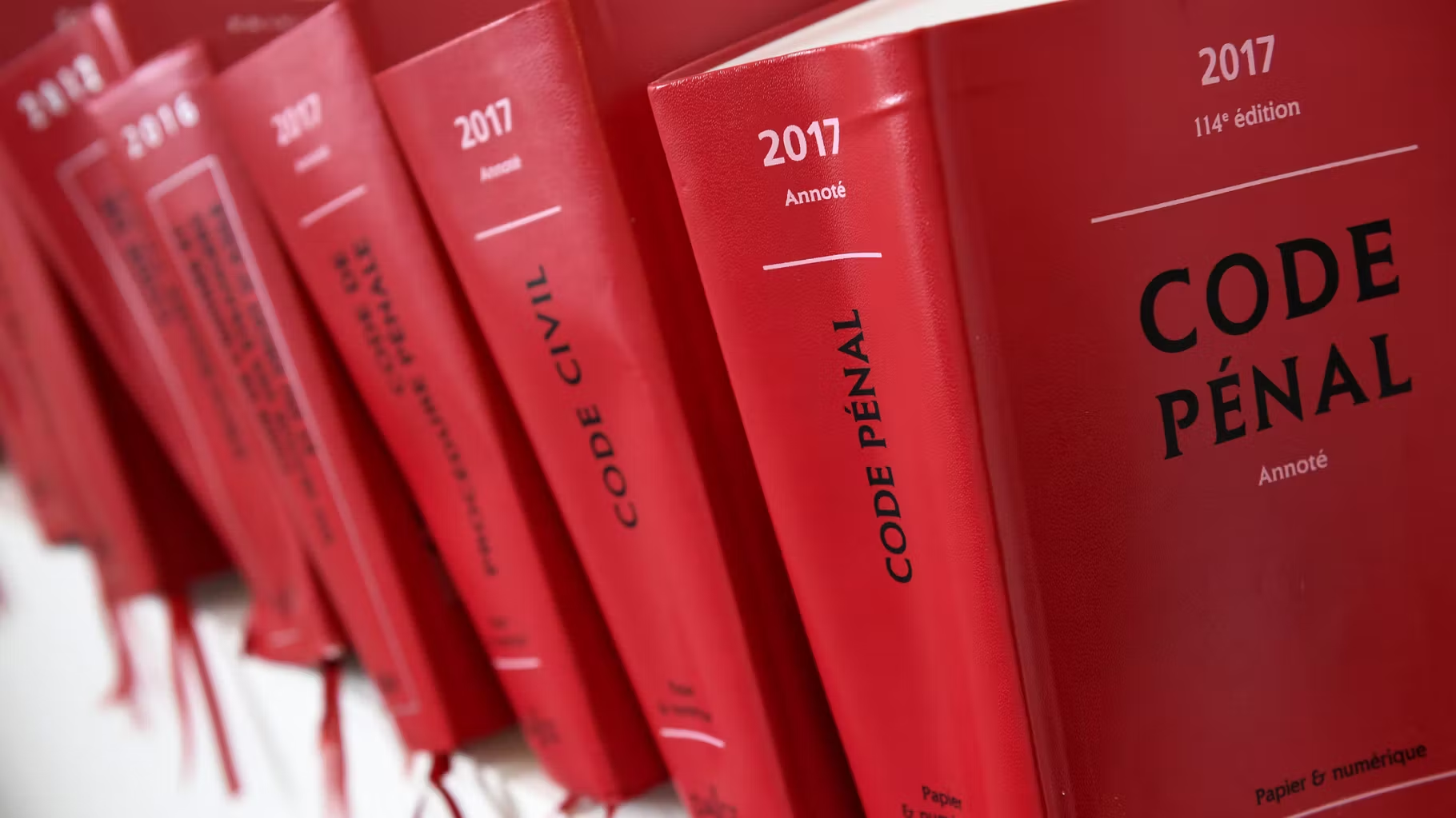
A holiday rental is governed by the Civil Code and the Tourism Code. The Civil Code sets out a useful rule to know. In the absence of an inventory, the guest is presumed to have received the property in good condition. This can work in your favour, but a signed document is far safer. The authorities are clear on this point.
In a holiday let, the deposit is not regulated by law. You can cash the cheque. But without an inventory of fixtures, a deduction becomes very hard to justify. It is this document that turns a mere suspicion into solid proof. We carry it out systematically for every managed stay.
When and how to carry out the inventory of fixtures
A good inventory is done at two moments, with both parties present. It is the check-in versus check-out comparison that carries weight. Here is the method.

- At check-in: record the condition of the property when handing over the keys.
- At check-out: use the same document and compare, point by point.
- Jointly: both parties inspect together and sign.
- Read the meters: water and electricity, both at check-in and check-out.
With a self check-in, being physically present is often impossible. Two practices then exist. You send a pre-filled inventory with photos, and the guest reports any issue within 24 hours. Or you use a dedicated app, with time-stamped photos and an electronic signature.
What is your property's potential?
Get a free, no-commitment rental audit from our on-the-ground team.
What should an inventory of fixtures contain?
A standard lease template is not enough. A holiday let requires specific sections. Here are the elements to include.
- Identification: parties, property address, check-in and check-out dates.
- Room-by-room description: walls, floors, ceilings, bedding, windows.
- Equipment and furniture: appliances, crockery, with their working condition.
- Written inventory: the precise list of items made available.
- Meter readings: water, electricity, gas where applicable.
- Dated photos: attached and referenced by room.
- Signatures of both parties: with the date, at check-in and check-out.

To save you time, we provide an inventory of fixtures template designed for holiday lets. It includes all the essential sections, with a check-in column and a check-out column to make comparison easier.
Photograph each room at check-in, even with no visible damage. Time-stamped photos are often worth more than a long description. In the event of a dispute, they show the exact condition of the property at a precise moment. It is the reflex that best protects your property on the Côte d'Azur.
The value of the inventory of fixtures in a dispute
The inventory of fixtures is your best proof in the event of damage. It lets you attribute damage to the guest and justify a deduction. Its strength rests on three elements.
First, the comparison between check-in and check-out. Then, the time-stamped photos, which objectively record the condition observed. Finally, the signatures of both parties, which make the document enforceable. An inventory not signed by the guest has little value. The French Directorate General for Competition, Consumer Affairs and Fraud Control (DGCCRF) makes this clear.
A question about your project?
Talk directly with your local Vesna agent. Available, responsive, no commitment.
Entrust the protection of your property to experts
Carrying out a rigorous inventory of fixtures for every stay takes time and presence. Would you like to delegate the management of your property on the Côte d'Azur? Contact the Airbnb Concierge Service in Nice. We protect your property, stay after stay.
Holiday letting also involves an administrative side to keep track of. Remember your supporting documents for the Airbnb invoice, the commission and fees charged, and Airbnb taxation. If a dispute remains unresolved, you can also contact Airbnb.
Frequently asked questions
- 1.Location saisonnière : les règles à connaître — DGCCRF / economie.gouv.fr, April 2026. economie.gouv.fr/dgccrf/les-fiches-pratiques/location-saisonniere-les-regles-connaitre
- 2.Location de vacances entre particuliers (meublé de tourisme) — Service-Public.fr, October 2024. service-public.gouv.fr/particuliers/vosdroits/F2045
- 3.Code civil, articles 1708 à 1831 (du louage) — Légifrance, 2026. legifrance.gouv.fr/codes/section_lc/LEGITEXT000006070721/LEGISCTA000006118109/
- 4.Code du tourisme, articles L324-1 à L324-2-1 — Légifrance, 2026. legifrance.gouv.fr/codes/id/LEGISCTA000006158462/
- 5.Loi n°89-462 du 6 juillet 1989 — Légifrance, 2026. legifrance.gouv.fr/loda/id/JORFTEXT000000509310/
Read also