Airbnb service fees are commissions charged by the platform to cover operating costs and ensure service quality. Understanding these fees is essential to set appropriate pricing and maximise your revenue. Airbnb offers two main options: 1. the shared model between host and guest and 2. the model where the host covers 100% of the fees.
Option 1:
Airbnb service fees shared between host and guest
Concept and calculation method
In this model, the most common one, fees are split between host and guest. For the host, fees generally amount to 3% excl. VAT (3.6% incl. VAT) of the booking subtotal.
This subtotal includes the nightly price and other fees charged by the host, but excludes guest service fees and taxes.
For guests, service fees generally range between 5% and 15% of the subtotal, depending on various factors such as length of stay and total booking amount.
Calculation example
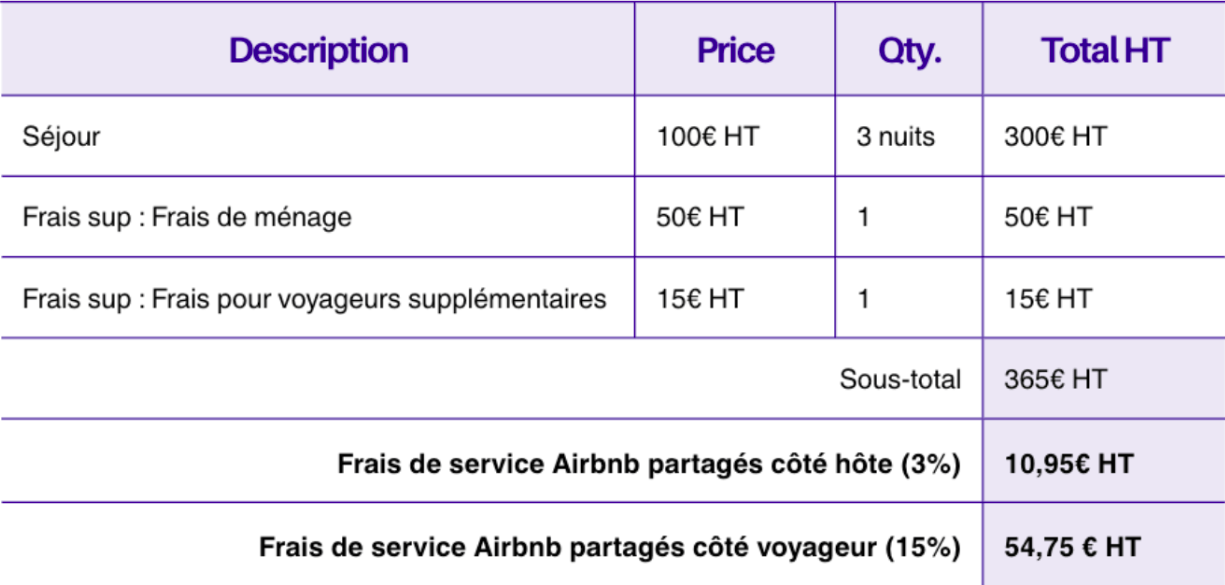
If you rent your apartment at €100 per night for a 3-night stay with a €50 cleaning fee, and an additional fee for 1 guest (€15 excl. VAT), the subtotal would be:
Subtotal = (100 × 3) + 50 + 15 = €365 excl. VAT
Host service fee = 365 × 3% = €10.95 excl. VAT
Pros VS Cons
| Pros | Cons |
|---|---|
| Relatively low fees for the host (3% excl. VAT) | Price displayed to the guest increased by service fees |
| Cost transparency for the guest | Risk of discouraging some bookings due to the higher final price |
| Fair sharing of fees between host and guest | Net revenue calculation potentially more complex for the host |
What is your property's potential?
Get a free, no-commitment rental audit from our on-the-ground team.
Option 2:
Service fees 100% covered by the host (simplified pricing)
Concept and calculation method
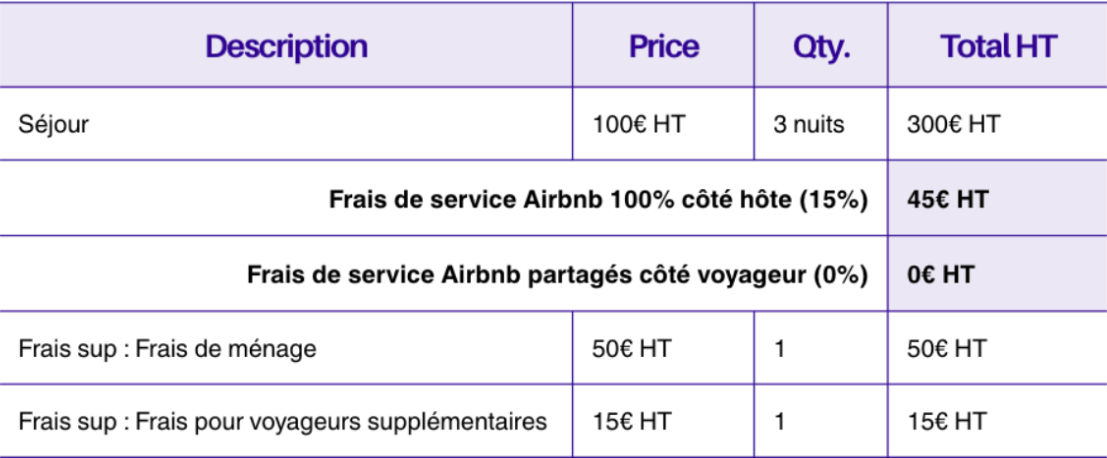
In this case, the host covers all the fees, generally between 14% and 16% of the booking subtotal. The guest sees no additional fees added to the displayed price.
This option is mandatory for certain types of accommodation, notably hotels and tourist residences. It is also recommended for hosts who use third-party management software to sync their calendars.
Calculation example
Pros VS Cons
| Pros | Cons |
|---|---|
| Can encourage bookings | Requires carefully calculated pricing |
| Price transparency for the guest | Higher fees for the host (14-16% vs 3%) |
Factors that affect the shared service fee percentage
- Cancellation policy: Fees may be higher with a strict policy. Flexible policies sometimes result in lower fees.
- Length of stay: For long-term stays (28 nights or more), fees may be adjusted.
- Promotions and discounts: Airbnb may offer promotions that affect the fee amount for the guest.
Be sure to increase your nightly rate to absorb the fee difference if you choose this option.
A question about your project?
Talk directly with your local Vesna agent. Available, responsive, no commitment.
Other fees to take into account
Fees for hosts using a co-host (concierge service)
Airbnb offers owners a welcome flexibility by allowing them to collaborate with co-hosts, such as concierge services.
The co-host system works as follows:
- Hosts can designate a co-host on their Airbnb account.
- Two remuneration methods available: a) a percentage of each booking, b) a fixed amount per booking.
- Airbnb charges no additional fees on payments made to co-hosts.

VAT
The VAT question is an important aspect to consider for owners using Airbnb in France.
- VAT rate: Airbnb service fees are subject to 20% VAT in France.
- For individual hosts: VAT is generally included in the service fees you pay to Airbnb.
- For professional or VAT-registered hosts: The situation may differ.
Make sure to keep all documents relating to your service fees and VAT to facilitate your tax returns.
Cancellation fees for owners
- Airbnb offers several cancellation policies (flexible, moderate, strict, etc.).
- The choice of policy can influence your fees and your attractiveness to guests.
- In general, Airbnb does not refund service fees to hosts in the event of cancellation by the guest.
- If you cancel a booking, you may be subject to penalties.

FAQ
No, it is generally not possible to switch models at will. Airbnb often assigns the model based on the type of accommodation and the frequency of rentals.
You can contact Airbnb customer service to discuss your options. Certain types of accommodation, such as hotels, are mandatorily subject to the simplified model.
Refundability depends on the cancellation policy chosen and the timing of the cancellation:
- If the guest cancels before the deadline, Airbnb generally refunds the fees to the guest.
- If the cancellation occurs after this deadline, fees are generally not refunded.
- In the simplified model (100% host), fees follow the same policy as the rest of the payment.
- Professional management: experience and resources to manage your property effectively.
- Revenue optimisation: rate adjustment based on demand.
- 24/7 availability: handling requests at any hour.
- Regulatory compliance: knowledge of local regulations.
- Emergency management: rapid response to unexpected problems.
- Quality improvement: better reviews and ranking.
Generally, yes. Fees may be considered deductible expenses for owners who declare their rental income.
- Micro-BIC regime: These fees are already factored into the flat-rate allowance (50% for classified furnished rentals, 30% for non-classified). They do not need to be deducted separately.
- Real regime: Fees can be deducted as operating expenses.
Consult an accountant to determine precisely how these fees apply to your situation.
Read also