The tourist tax (taxe de séjour) is paid by your guest, not by you. On Airbnb, the platform collects it and remits it directly to your municipality since 2019. But you are not entirely free of obligations. Here is how this mechanism works and what you need to check.
What Is the Tourist Tax?
The tourist tax (taxe de séjour) is a local tax created in 1910. Municipalities and inter-municipal groups (EPCI) may choose to apply it on their territory. It is not a national requirement: each local authority decides freely.

It primarily funds expenses related to local tourism. This includes destination promotion, maintenance of tourist facilities and development of visitor infrastructure.
This is the number of French municipalities currently applying the tourist tax.
The tourist tax is entirely separate from your rental income. It never belongs to you. You collect it on behalf of the municipality, then remit it.
Who Pays the Tourist Tax: the Guest or the Host?
It is the guest who pays the tourist tax, not you.
As a host, you are simply the collection intermediary. Your role: collect the tax from the guest, then remit it to your municipality within the locally set deadlines.
On Airbnb, this mechanism is entirely automated. The platform displays the tax separately in the guest’s booking summary. It collects the amount at the time of payment. It then remits the sum directly to your municipality. You never see it pass through your income.
Some guests ask about this additional line in their booking summary. We recommend anticipating the question in your welcome booklet or automatic messages. Simply explain that it is a mandatory municipal levy, unrelated to your price. This avoids misunderstandings and unjustified negative reviews.
How Airbnb Collects the Tourist Tax Automatically
Since January 2019, Airbnb has collected and remitted the tourist tax directly to French municipalities. The host is not involved in this process.
-
01
At the time of booking
Airbnb identifies the property’s municipality and applies the applicable local rate.
-
02
At the time of payment
The tax is automatically deducted from the total amount paid by the guest.
-
03
After the stay
Airbnb remits the funds directly to the municipal treasury, in line with the municipality’s filing calendar.
Airbnb covers approximately 95% of French municipalities that apply the tourist tax. In the remaining 5% (recent municipalities, late rate updates, inter-municipal groups not yet integrated), automatic collection does not work. In that case, you must collect and remit it manually.
You can check whether your municipality is covered directly from your Airbnb host dashboard, in your listing settings.
The Tourist Tax Rate Schedule in 2026
The tax amount varies according to two criteria: the type of accommodation and the rate set by the municipality.
For classified accommodation (furnished tourist rentals with Atout France star rating), municipalities apply a fixed rate in euros, per night and per person. Here are the 2026 national ceilings:
| Category | National floor | National ceiling |
|---|---|---|
| 5-star furnished rental | €0.70 | €3.60 |
| 4-star furnished rental | €0.70 | €2.60 |
| 3-star furnished rental | €0.50 | €1.70 |
| 2-star furnished rental | €0.30 | €1.00 |
| 1-star furnished rental | €0.20 | €0.80 |
| Bed and breakfasts | €0.20 | €0.80 |
For unclassified furnished rentals (the vast majority of Airbnb listings), the calculation is different. The municipality sets a rate between 1% and 5% of the price excluding VAT per night and per person, up to the municipal ceiling.
Concrete example: for a flat rented at 80€ per night, with a local rate of 3%, the tourist tax amounts to 2.40€ per guest per night. For 2 guests over 3 nights, the total tax collected will be 14.40€.
If your property is in Île-de-France, a regional surcharge of 200% applies on top of the municipal rate. On the Côte d'Azur, an additional tax of 34% has applied since January 2023 to finance the Ligne Nouvelle Provence Côte d'Azur rail project.
For the precise amounts applicable in Nice, see our dedicated guide on the tourist tax in Nice. Our Airbnb concierge service in Nice tracks these amounts on behalf of the hosts we support.
Which Municipalities Apply the Tourist Tax?
The tourist tax is not mandatory everywhere. Each municipality or inter-municipal group votes to introduce it before 1 July, for entry into force on 1 January of the following year.
In practice, tourist municipalities are very largely concerned. All major French cities (Paris, Nice, Lyon, Bordeaux, Marseille) have introduced it. Seaside resorts, Alpine destinations and almost all coastal municipalities also apply it.
To find out whether your municipality is concerned, three options:
- Visit the official website taxesejour.fr, which lists rates by municipality
- Contact your town hall or inter-municipal group directly
- Check your Airbnb dashboard: if collection is automatic, your municipality is covered
A question about your project?
Talk directly with your local Vesna agent. Available, responsive, no commitment.
Who Is Exempt from the Tourist Tax?
Exemptions are defined by articles L2333-29 to L2333-31 of the French General Code of Local Authorities. Four categories benefit from a statutory exemption:
- Minors under 18: no tax must be collected for them
- Permanent residents of the municipality: a person domiciled in the area is not subject to the tax
- Seasonal workers: employed within the territory of the relevant municipality
- People in emergency accommodation: or in temporary rehousing through social services
On Airbnb, the automatic calculation is based on the number of guests declared in the booking. If you are hosting children, check that the count is correct in the booking summary.
Important point: a person accommodated free of charge (promotional offer, gift, promo code) remains liable for the tourist tax, even if they do not pay for the accommodation.
How to Check the Tourist Tax on Your Airbnb Statements
Even if Airbnb handles collection, you must regularly check the amounts. The platform makes this information available to you in three places:
In the summary of each booking: open the booking in your dashboard. The payment breakdown distinguishes your host income and the tourist tax collected separately.
In your monthly transaction statement: the statement presents your net rental income on one side, and the taxes collected on the other.
In the Tax section of your host account: Airbnb summarises the amounts collected and remitted by municipality, for the period of your choice.
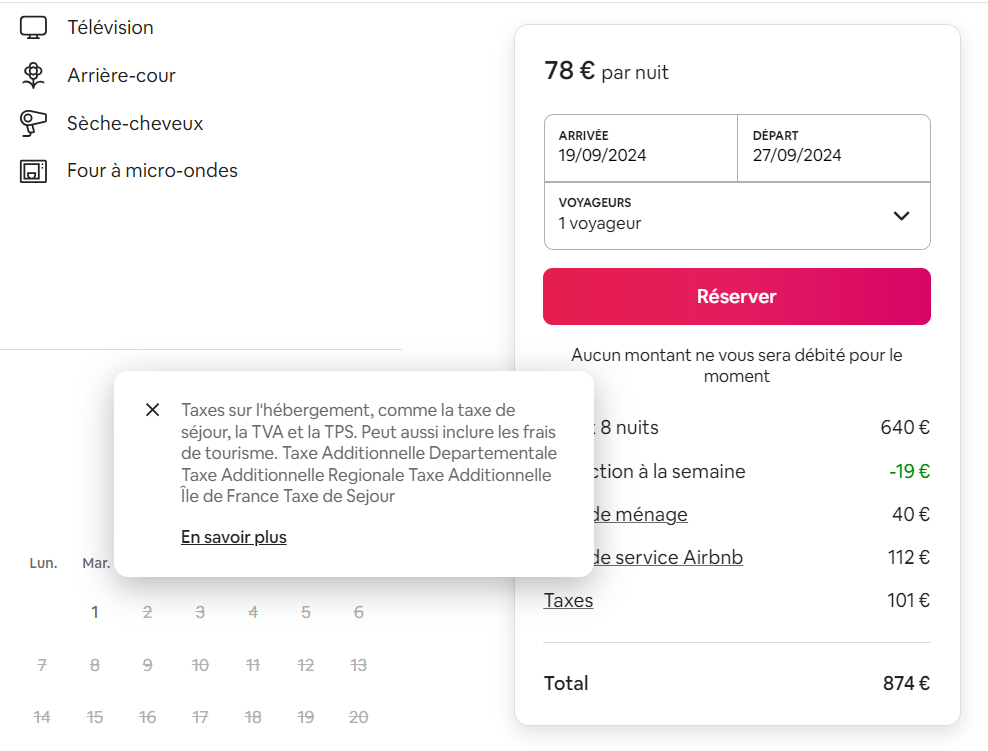
The tourist tax does not appear in your taxable income. It must not be declared as rental income. For everything relating to the taxation of your Airbnb income, read our guide Airbnb Taxation: Understanding How You Are Taxed.
What to Do If Airbnb Does Not Collect in Your Municipality?
In approximately 5% of French municipalities, Airbnb does not provide automatic collection. You must then manage the tax yourself in four steps:
-
01
Calculate the amount
Multiply the municipal rate by the number of adult guests and by the number of nights.
-
02
Inform the guest in advance
State clearly in your listing and messages that the tourist tax will be paid directly, outside the platform.
-
03
File via the online declaration portal
Use your municipality or inter-municipal group’s portal (monthly, quarterly or annual frequency depending on the authority).
-
04
Remit within the allotted deadlines
Risk of a fine of up to 750€ otherwise.
For the administrative steps at your town hall, our guide Airbnb Registration Number: Steps at the Town Hall will give you the basics of local declaration obligations.
Even when Airbnb collects automatically, some municipalities require an additional declaration from the host. The Métropole Nice Côte d'Azur, for example, asks hosts to declare their stays via its municipal portal, ticking the box “collection by intermediary”. Check with your local authority to avoid receiving a formal notice.
What Is the Tourist Tax Used For?
The tourist tax is a local fiscal resource allocated to tourism development. Municipalities and inter-municipal groups use it to fund:

- Tourism promotion for the destination (tourist office, communication campaigns)
- Maintenance and development of cultural and tourist facilities
- Visitor infrastructure (signage, soft mobility, green spaces)
In France, the amounts collected have risen sharply since 2019. The direct collection mechanism via platforms has considerably improved the transparency and yield of this local tax.
Key Takeaways
The tourist tax costs you nothing. It is paid by your guests. Airbnb manages collection automatically in 95% of French municipalities. Your three remaining responsibilities:
- Check that your municipality is covered by Airbnb’s automatic collection
- Verify that the amounts deducted match the rates in force
- Declare your stays to your local authority if it requires it, even with automatic collection in place
Short-term rental regulations change every year. To stay up to date on all your legal obligations, read our guide Airbnb Regulations in 2026: The Laws You Need to Know.
- 1.Tourist tax: what are the rates? — Service-Public Entreprendre, January 2026.
- 2.Practical guide to tourist tax (v5) — Ministry of the Economy / DGFiP, 2024.
- 3.Articles L2333-29 to L2333-31 of the CGCT — Légifrance.
- 4.Collection and payment of tourist tax in France — Airbnb Help Centre, 2024.
- 5.2026 tourist tax rates - Métropole Nice Côte d'Azur — Métropole NCA.
Read also