The registration number (numéro d'enregistrement) is a unique 13-digit identifier issued by your local town hall. It is mandatory for any furnished tourist rental (meublé de tourisme) in France. Without this number, your Airbnb listing can be suspended. You risk a fine of up to 10,000 €. Here are the exact steps to obtain it.
What is the Airbnb registration number?
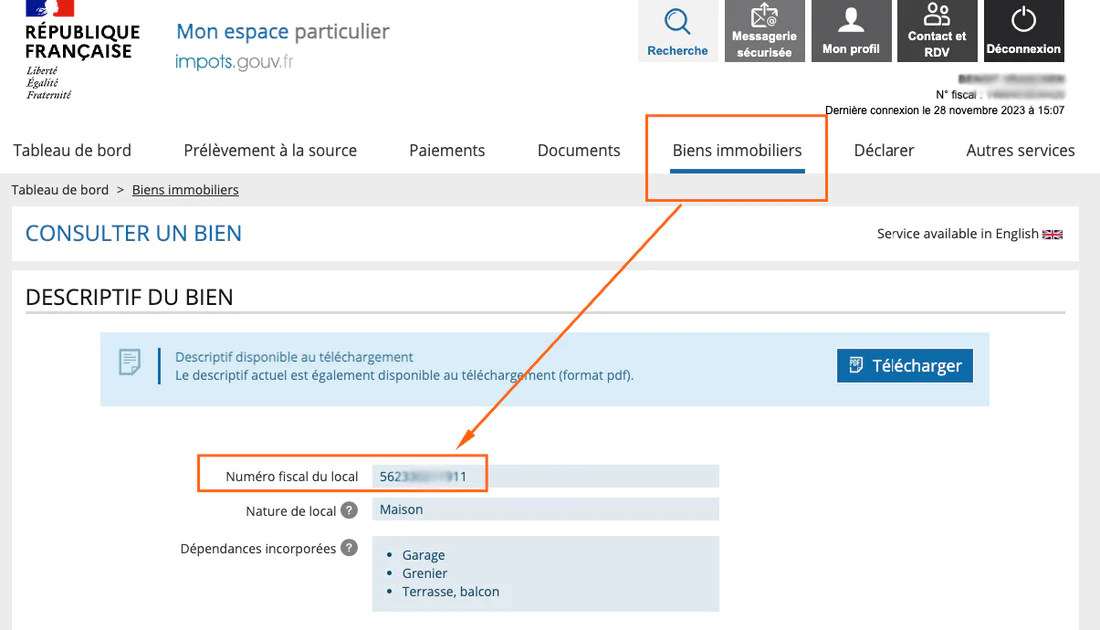
The registration number is a 13-digit identifier assigned by the town hall. It identifies your property as a registered furnished tourist rental (meublé de tourisme déclaré).
This number was introduced by decree in 2017, then reinforced by the ELAN Act (loi ELAN) of 2018. The Le Meur Act of 19 November 2024 tightened obligations further. By 20 May 2026, all French municipalities must have an online registration portal (téléservice).

Registration is entirely free. It has unlimited validity, unless you change property. One number corresponds to one property only. If you rent several properties, each requires its own declaration.
This is the deadline by which all French municipalities must offer an online registration portal for furnished tourist rentals.
Which municipalities require the registration number?
The obligation does not apply in the same way everywhere. Three categories of municipalities are concerned.

Paris and the inner suburbs (Hauts-de-Seine, Seine-Saint-Denis, Val-de-Marne): obligation in force since 2017.
Cities with more than 200,000 inhabitants: Lyon, Marseille, Toulouse, Bordeaux, Nice, Strasbourg, Nantes, Montpellier, Lille, Rennes.
Municipalities in high-demand zones (zone tendue) that have voted to introduce registration are also concerned.
For a complete overview of your legal obligations, see our guide Airbnb regulations in 2026: the laws you need to know.
How to obtain your registration number
The procedure depends on your municipality and the type of property. Here are the steps in order.
-
01
Check your situation
Identify whether your property is your primary or secondary residence. This affects the procedure.
-
02
Access your town hall's online portal
More and more municipalities offer a dedicated online portal.
-
03
Fill in the declaration
Provide your identity, the property address, the number of rooms and beds, and the property's status.
-
04
Receive your number
The 13-digit number is issued immediately online. By post, allow a few days.
-
05
Add the number to your listings
Airbnb, Booking, Abritel and any other platform.
For municipalities that do not yet have an online portal, the declaration is made using CERFA form no. 14004*04. You can fill it in online or send it by recorded delivery. The town hall then issues a receipt that serves as a registration number.
What documents are needed for the declaration?
The documents required vary slightly from one municipality to another. Here is the standard set required everywhere.

- Identity document - of the owner.
- Proof of ownership - title deed or latest property tax notice (taxe foncière).
- Full address - of the property.
- Property description - number of rooms, beds and maximum occupancy.
- Sworn statement - specifying whether the property is your primary or secondary residence.
- Energy performance certificate (DPE) - rated A to E.
Prepare your energy performance certificate (DPE) before starting the declaration. A property without a DPE, or rated F or G, cannot obtain a registration number. Arrange the assessment in advance to avoid delaying your listing.
Where to add the registration number in your Airbnb listing
The number must appear on every published listing. On Airbnb, the procedure is straightforward.
-
01
Log in to your host account
-
02
Open the relevant listing
-
03
Go to "Settings" then "Laws and regulations"
-
04
Enter your 13-digit registration number
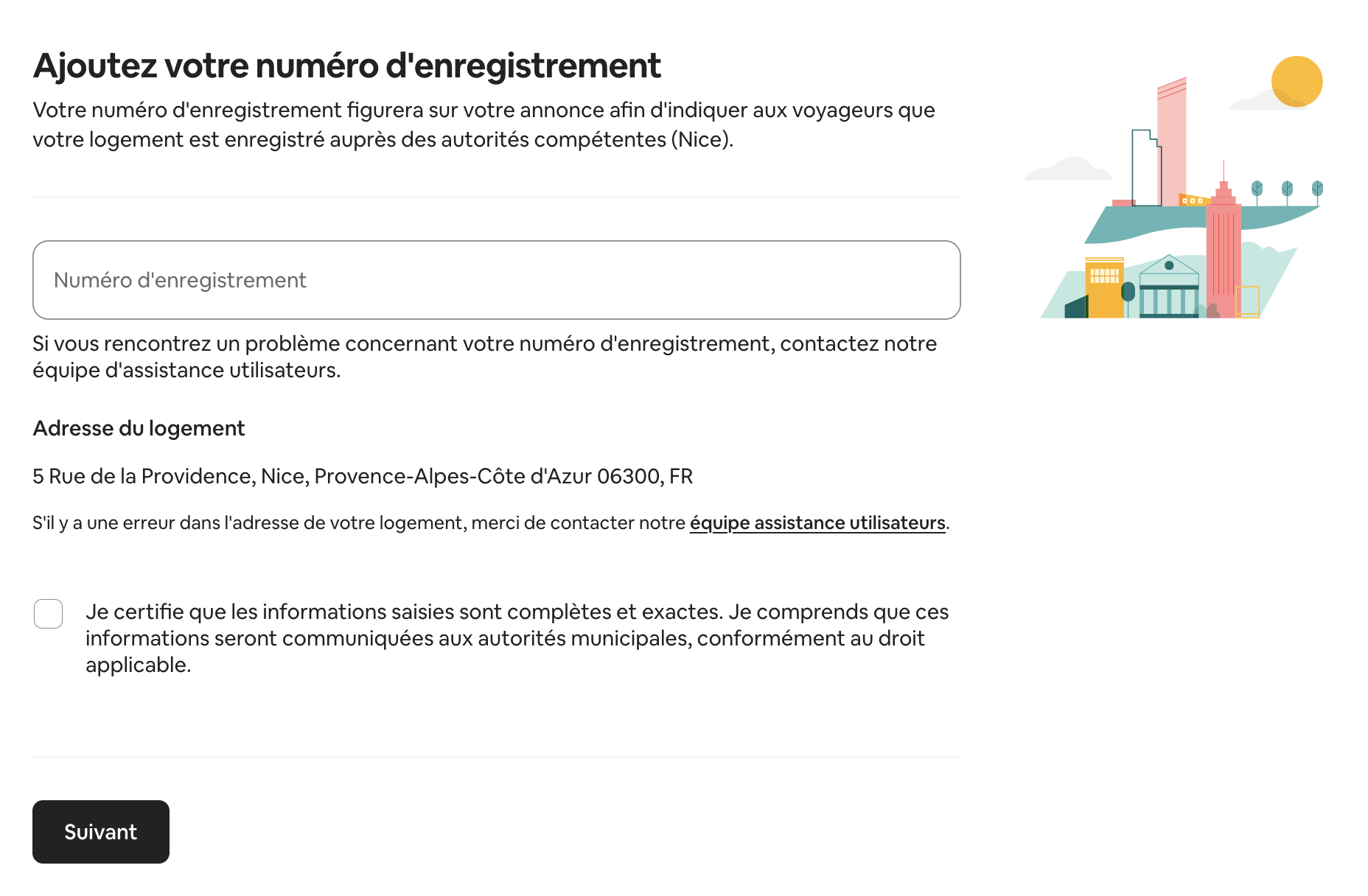
If you are new to short-term rental, our guide How to rent on Airbnb: the beginner owner's guide covers all the steps to get listed. For owners on the Côte d'Azur, our Airbnb concierge service in Nice can handle these administrative procedures on your behalf.
What penalties apply if you have no registration number?
The Le Meur Act of 19 November 2024 has strengthened penalties. Fines have been multiplied compared to the previous regime.
| Infringement | Maximum fine |
|---|---|
| Non-compliance with energy performance (DPE) or habitability standards | 5,000 € per property |
| Failure to register | 10,000 € (administrative) |
| Exceeding the authorised number of rental days | 15,000 € (civil) |
| False declaration or fraudulent registration number | 20,000 € (administrative) |
| Failure to submit the energy performance certificate | 100 € per day penalty |
These penalties are imposed by the mayor. Platforms such as Airbnb are also required to verify that a registration number is present. Without a valid number, they must suspend the listing.
To understand how your rental income is taxed, see our guide Airbnb taxation: a complete guide to tax on rental income.
A question about your project?
Talk directly with your local Vesna agent. Available, responsive, no commitment.
Change of use: the additional step for secondary residences
If your property is your secondary residence, the registration number alone is not sufficient in certain municipalities. You must also obtain a change-of-use authorisation (autorisation de changement d'usage).
This obligation applies to municipalities with more than 200,000 inhabitants. Municipalities in high-demand zones that have passed a resolution to this effect are also concerned. In practice, you are asking the town hall to temporarily reclassify your property's residential use as tourist use.
| Criterion | Primary residence | Secondary residence (high-demand zone) |
|---|---|---|
| Town hall declaration | Mandatory | Mandatory |
| Registration number | Yes | Yes |
| Change of use | Not required | Mandatory |
| Compensation | No | Possible depending on the municipality |
| Duration limit | Yes, set by the municipality | No annual limit |
Failure to comply with the change-of-use obligation carries the heaviest penalty in the scheme. The civil fine can reach 100,000 €.
Key takeaways
The registration number is a legal obligation for any owner renting out a furnished tourist property. The procedure is free and quick in most municipalities. Penalties, however, are severe in the event of non-compliance.
Your three priorities:
-
01
Check whether your municipality already requires a registration number
-
02
Submit the declaration at the town hall
Online or using CERFA form 14004*04.
-
03
Add the number to all your listings before 20 May 2026
If your property is a secondary residence in a high-demand zone, add the change-of-use authorisation to your list of steps.
- 1.Renting out a secondary residence as a furnished tourist rental - Service-public.fr, 2025.
- 2.Law no. 2024-1039 of 19 November 2024 (Le Meur Act) - Légifrance, November 2024.
- 3.Tourist rentals: new rules in 2025 - Service-public.fr, January 2025.
- 4.Find out about registration to rent on Airbnb - Airbnb, 2025.
Read also