Do you own a property in Nice and dream of renting it out on Airbnb? Beware, the ELAN Law could well upset your plans!
Nice and the Côte d'Azur: the municipalities concerned by the ELAN Law
The ELAN Law primarily targets 18 French cities classified as high-demand zones. Nice is one of them, alongside Paris, Lyon and Bordeaux. On the Côte d'Azur, several neighbouring municipalities are also affected.
To see all the cities concerned in France and their night limit (90 or 120 days), read our national guide: Airbnb regulations in 2026: what the law requires of owners.
Unsure about your municipality? The government offers an official high-demand zone simulator →.
Cities concerned around Nice
This region, renowned for its tourist appeal and dynamic property market, is particularly affected by the provisions of the ELAN Law.
Nice, with its 342,637 inhabitants (INSEE 2018 figures), is on the front line. But it is not the only Côte d'Azur municipality concerned.
Les communes de la Côte d’Azur concernées
Survolez (ou touchez) une commune du littoral pour afficher ses informations.
View the list of affected municipalities
| City | Postal code | Inhabitants |
|---|---|---|
| Nice | 06000 | 342,637 |
| Antibes | 06600 | 74,920 |
| Cannes | 06400 | 73,868 |
| Cagnes-sur-Mer | 06800 | 48,771 |
| Saint-Laurent-du-Var | 06700 | 30,234 |
| Menton | 06500 | 28,231 |
| Vence | 06140 | 19,000 |
| Villeneuve-Loubet | 06270 | 15,041 |
| Roquebrune-Cap-Martin | 06190 | 12,824 |
| Villefranche-sur-Mer | 06230 | 5,109 |
| Beaulieu-sur-Mer | 06310 | 3,731 |
| Saint-Jean-Cap-Ferrat | 06230 | 1,573 |
| Cap d'Ail | 06320 | 4,709 |
Their inclusion is explained by:
- Strong property-market pressure linked to tourist appeal
- A tight rental market, with difficulties accessing housing for permanent residents
- A high proportion of second homes and seasonal rentals
This list is not set in stone. Other municipalities could be added to the scheme in the future.
What is your property's potential?
Get a free, no-commitment rental audit from our on-the-ground team.
Seasonal rental regulations: the ELAN Law and the Le Meur Law
Rules for primary residences
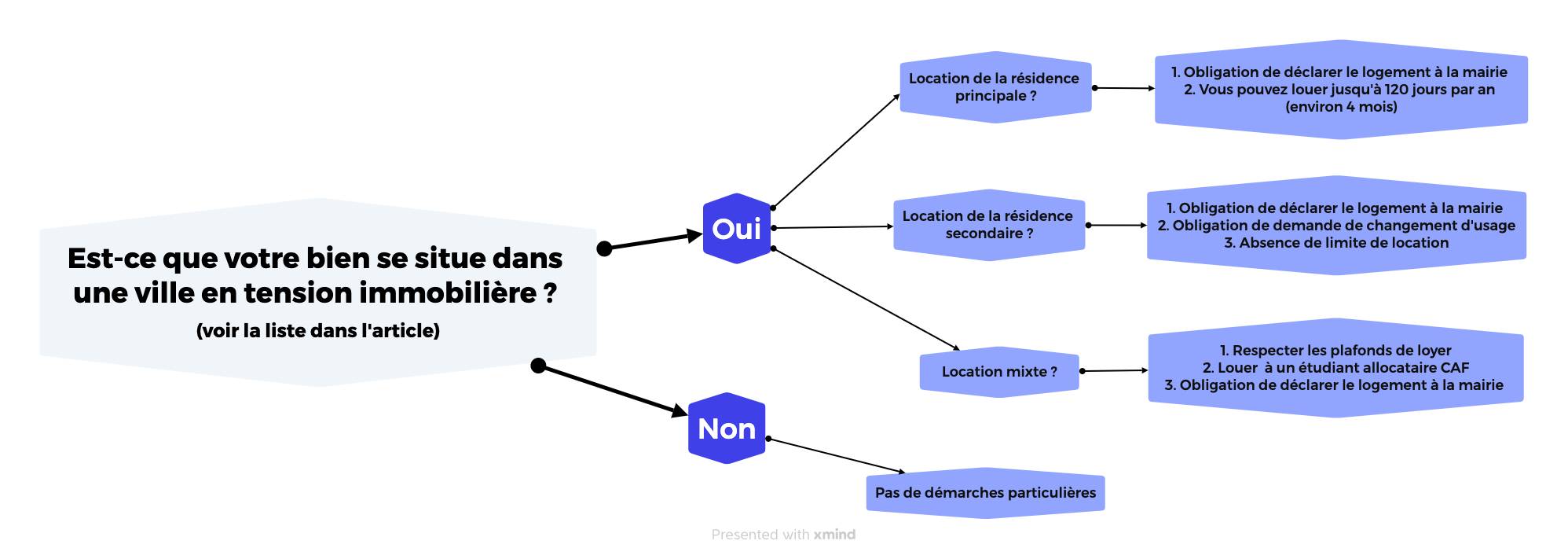
What is a primary residence? It is the home where you live at least 8 months a year. This definition determines the rules to follow.
How long can you rent it out? Up to 120 nights a year, the national cap. Since the Le Meur Law, your municipality can lower it to 90 nights a year.
What must you do before renting?
- Declare your property to the town hall, even for a single night.
- Obtain a 13-digit registration number.
- Display this number on all your online listings.
How are the rules enforced?
- Platforms like Airbnb automatically block listings once the cap is reached (120 nights, or 90 nights if your municipality has decided so).
- These platforms report the number of nights rented to the town halls every year.
Penalties:
- Up to €5,000 fine if you fail to declare your property.
- Up to €10,000 if you exceed the day limit.
The 90-night rule: what the Le Meur Law changes
The Le Meur Law (Law no. 2024-1039 of 19 November 2024) strengthened municipalities' powers over furnished tourist accommodation. It is what explains the well-known "90-night rule".
The national cap remains set at 120 nights a year. But since 2025, each municipality can lower it to 90 nights by deliberation. On the Côte d'Azur, Nice and its neighbours are the most affected.

How do you know if your municipality applies the 90 nights? The decision is taken by the town council. Before publishing your listing, check the deliberation in force with your town hall.
The Le Meur Law also generalises the registration of furnished tourist accommodation: eventually, every property will need a registration number, even outside high-demand zones.
Source: Law no. 2024-1039 of 19 November 2024 (Légifrance).
Rules for second homes
Côte d'Azur example: in Antibes, a change of use is only allowed in certain neighbourhoods, to keep a balance between tourists and permanent residents.
Rules for mixed rentals
The city of Nice has set up an innovative scheme: mixed rental. Renting to a student during the university year and to tourists during the summer.
This solution allows owners to maximise the occupancy of their property while contributing to the supply of student housing. It is a good compromise between profitability and social usefulness, specifically suited to the Nice context.
Do not forget: the rules can change. Always check the City of Nice website for the most up-to-date information!
A question about your project?
Talk directly with your local Vesna agent. Available, responsive, no commitment.
Read also